
Franklin County Criminal Docket Searches
The clerk publishes criminal dockets as dated files rather than a name-search form. The Circuit criminal docket page posts these sheets. So does the General Sessions criminal docket page. Circuit handles felony trials, since the 12th Judicial District has no separate Criminal Court. General Sessions takes misdemeanor trials in authorized cases plus felony preliminary hearings. For deeper history, the clerk offers Tennessee Case Search through TNCIS. Its public description covers filings, service, charges, hearings, attorneys, fees, and payment history. All of it relates to Franklin County court records.
- Identify the court on the notice or filing.
- Open the matching court docket page.
- Select the date and read the heading.
- Check whether the file says preliminary.
- Ask the clerk for copies or certification.
Franklin Criminal Dockets Can Change
General Sessions usually posts its preliminary criminal docket near noon on the day before court. Earlier versions can change, so the clerk does not treat them as accurate. A case missing from an old sheet might still exist and still be set. That tight publication window serves a different purpose than a historic case lookup. It exists so a visitor can check a coming session after late changes land. Need an earlier Franklin County criminal docket? Contact the clerk. Anyone holding a downloaded copy should compare it against the newest official posting. Do not rely on it before then. The official preliminary docket notice carries this warning directly.
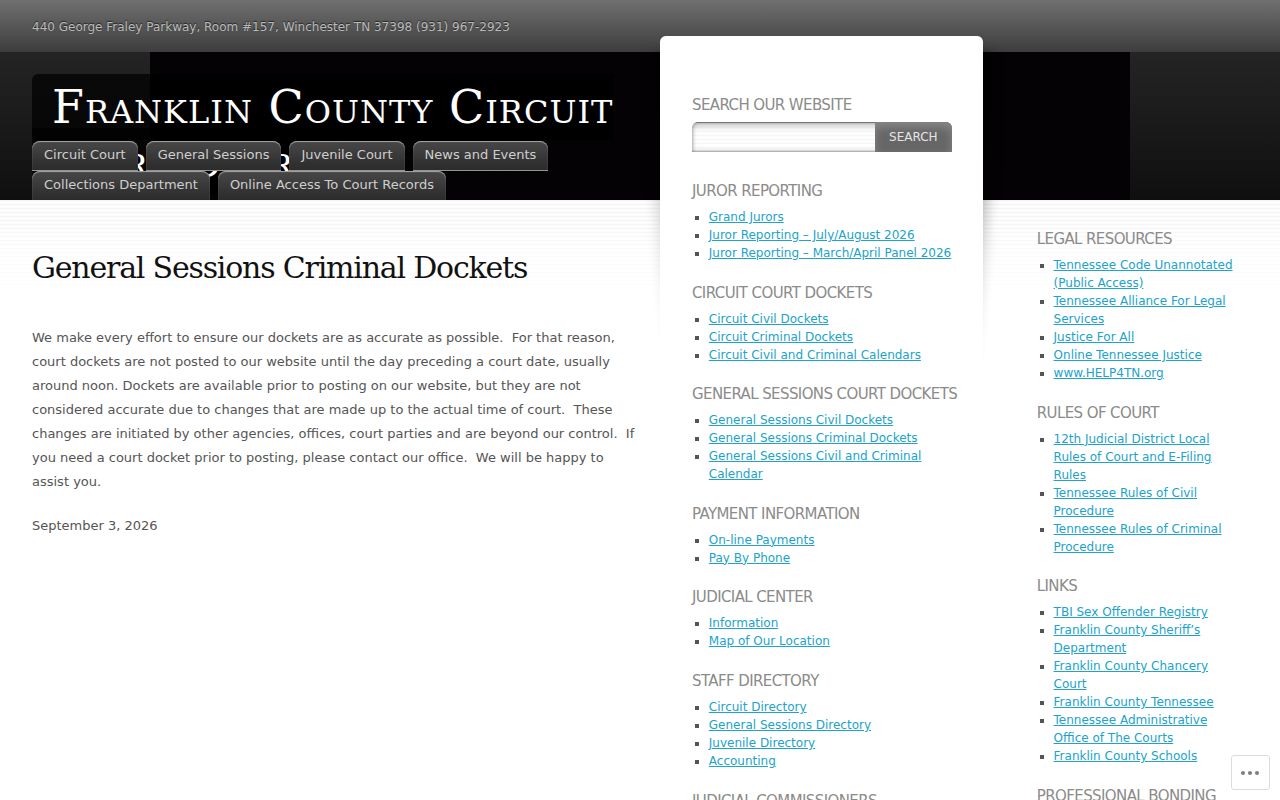
The image reinforces why an urgent setting should be confirmed with the clerk.
Criminal Dockets: What They Show
A Franklin County criminal docket PDF is mostly a schedule. It can list the court, the date, the judge or Part. It can also carry a label for the proceeding. A fuller case register may add filings and outcomes. Read those fields together. A Part marks a Circuit judicial assignment, not a different county. Check party names and case numbers against the actual court file. Two people can share a name. A calendar entry may be updated after publication.
| Court and date | The tribunal and session covered. |
|---|---|
| Judge or Part | A judicial assignment, not a separate county. |
| Proceeding | A plea, assignment, or preliminary label is not a proven conviction. |
| Case number | The court identifier, shown generically as Franklin case number. |
| Disposition | The recorded outcome, best checked in the certified file. |
A scheduled plea is not a ruling and proves no outcome.
Franklin Criminal PDF or TNCIS
Free PDF dockets show what is set near a date. For broader trial-court history, TNCIS updates each night at 8 p.m. The clerk cautions it is not the official record. Access costs $350 per year. Credentials come through the clerk. The public login screen reveals no search fields, sorting, or export tools. So do not guess how a case-number or name lookup behaves inside.
| Channel | Best use | Limit |
|---|---|---|
| Near-term setting | Not a full register | |
| TNCIS | Broader history | Subscription and unverified fields |
| Clerk | Inspection, copy, certification | Rules and fees vary |
If the online route leaves you unsure, go straight to the source. Robert Baggett's Circuit Clerk office keeps the Franklin County criminal docket and can answer what no screen can. A phone call costs nothing.
Know what question you are actually asking, though. TNCIS, with its nightly refresh, lets you follow a case over time: hearings, charges, filings, fees, payments. A clerk-certified copy is different. That is proof from the office holding the original Franklin County criminal record. It carries weight TNCIS printouts do not. Ask first which form of proof your situation needs, then pay for access or copies.
Criminal Case Stages on the Docket
Felony cases in Franklin County often travel through two courts. They start in General Sessions with a preliminary hearing. Then they move up to Circuit. Every step along the way can add its own entry to the criminal docket.
Misdemeanors usually stay put in Sessions. That depends on the court's conditions. What decides the route is the charge level, the waiver rules, and later court action. The city where the incident happened does not matter. Once a case is appealed, it leaves the trial docket behind. It then lands in the Tennessee appellate search.
Docket flow: Filing → Arraignment → Pretrial → Plea or Trial → Disposition → Sentencing
A reset is not a dismissal; assignment may be only a scheduling label. Diversion and nolle prosequi carry distinct meanings.
Reading Franklin Criminal Docket Terms
A short label tells you very little on its own. Pair it with the court, the date, and the event heading. Do that before drawing any conclusion about a Franklin County criminal docket entry.
These labels mark steps in a file. They are not a full account of the proceeding. That distinction matters. A pending charge is not a conviction, and a plea that is merely scheduled has not produced a final outcome.
- Preliminary hearing
- A Sessions step on a felony accusation, not the felony trial.
- Reset
- A new setting after a date moves.
- Disposition
- The recorded outcome.
- Nolle prosequi
- A prosecution-ending entry.
- Certified copy
- A copy authenticated by the custodian.
Ask for the order or certified disposition when the final result matters.
Franklin County Criminal Docket Courts
Felony trials in Franklin County belong to Circuit Court. General Sessions handles felony preliminary hearings plus the misdemeanor matters it is authorized to hear. Juvenile jurisdiction also sits in General Sessions, though that office uses separate contacts and its own access rules.
Franklin County is part of the 12th Judicial District. The Circuit overview lists Parts I, II, and III, so a Part label on a docket simply points to a judicial assignment within the district. It does not mean a separate records office exists.
For appeals, search Tennessee Public Case History. Federal cases live in PACER. A municipal citation may still sit with one of Franklin County's five city courts.
Franklin Criminal Clerk Access Channels
The Franklin County Circuit Court Clerk sits at 440 George Fraley Parkway, Room 157, Winchester, Tennessee 37398. The office answers at 931-967-2923. Hours run 7:30 a.m. to 4:30 p.m. on weekdays. For Juvenile matters, the clerk line is 931-962-2371. The Juvenile court office takes petition calls at 931-962-4133.
You can start a docket request online, by phone, at the counter, by mail, or through a formal records request. Give the court's name, the record you want, and the date range. Add a case number if you have one. Say upfront whether you need to inspect the file, get an ordinary copy, or pay for a certified copy.
Criminal record routing
Franklin County Judicial Center
440 George Fraley Parkway
Winchester, TN 37398
Circuit: 931-967-2923
Sessions: 931-967-2089
Juvenile: 931-962-2371
The Juvenile court office takes petition filings on its own phone line. That line sits apart from the main criminal clerk numbers. Written and mailed requests work better when they are precise. Say which division holds the file: Circuit criminal, General Sessions criminal, or Juvenile Court. Add a case number and a date range if you have them. Tell the clerk when you simply want to view the docket. Ask for a copy only if you want one. When a file is sealed or protected, the clerk will walk you through the access steps without opening the restricted contents.
Access Rules for Criminal Dockets
Tennessee Supreme Court Rule 34 governs the criminal docket record. It grants public access to court records, within statutes, court orders, and reasonable limits. Sealed material and protected identifiers stay withheld. For the request side of things, turn to the Tennessee Public Records Act FAQ. It lays out how a records custodian must respond.
Key rules:
Rule 34 preserves express exceptions.
Expungement guidance routes eligible filings to the originating court.
A sealed or expunged matter is not an ordinary public docket.
Franklin Juvenile Docket Privacy
Franklin County juvenile dockets do not follow adult criminal rules. Dependency and neglect records are closed entirely. Delinquent and unruly cases are usually open under Rule 114, unless a judge finds that closure is required to prevent prejudice. The Rule 114 page spells out that split.
Ask the Juvenile clerk directly. An adult Sessions file will not hold the answer. Expungement questions go back to the court that handled the case, too. The Tennessee Bureau of Investigation guidance separates diversion from expungement, and Tennessee Courts describes filing in the court where the matter began. A short docket label cannot tell you whether a record qualifies, so confirm the order and its public status with that court.