
Franklin County Court Docket Searches
Begin with the Franklin County Circuit Court Clerk, the office that posts the court's own schedules. The free pages list dockets as PDF links organized by date. Four sets appear: Circuit civil, Circuit criminal, General Sessions civil, and General Sessions criminal. What you get is a schedule, not a search box. The page has no fill-in field. Nothing there takes a name, a case number, a charge, or a date range. That free route works well. It helps when you already know the court and the likely hearing date. Sessions preliminary dockets usually appear around noon the day before court. They can still change after posting.
A practical Franklin County docket search follows a short sequence:
- Read the ticket, notice, or prior filing and identify the named court.
- Classify the matter as civil, criminal, Juvenile, Chancery, municipal, appellate, or federal.
- Check the matching free docket PDF or official calendar.
- Use TNCIS, appellate Public Case History, a city route, or PACER only when it fits.
- Call or write the proper clerk for older history, an absent item, or certification.
An empty date page proves nothing. A matter might sit outside the short publication window, belong to a different court, await an update, or be restricted from view.
Franklin Docket PDFs and TNCIS
Franklin County gives you two ways into trial-court records. Clerk PDFs cost nothing. They are organized by date. TNCIS works differently: a subscription priced at $350 per year, open around the clock, with nightly refreshes at 8 p.m.
| Route | Best use | Limit |
|---|---|---|
| Free PDFs | Known near-term date | No name query |
| TNCIS | Broader trial history | Not official proof |
| Clerk request | Copies and certification | Fees may apply |
The official clerk capture shows the county navigation used to reach these separate services.
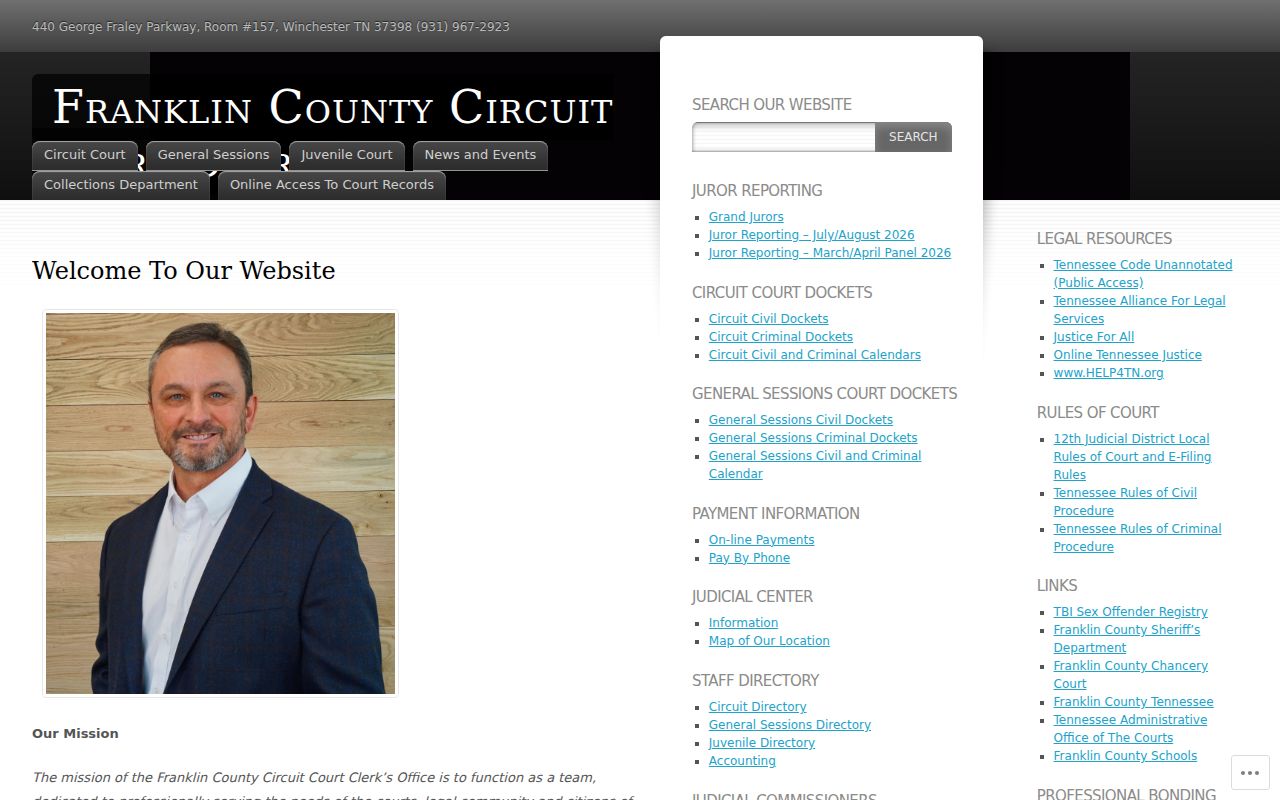
The menu lays out the pieces plainly. Dockets, calendars, forms, fees, and payments each sit in their own spot, related tasks with separate destinations.
Court Dockets: What They Show
In Franklin County, "docket" can mean a few things. A Circuit or Sessions PDF is usually a list of cases set for one date. A docket call is a session where settings get arranged. The case register is something else again: a running, chronological history of filings and events. So check the title and the source. Never treat one item as the whole story.
| Case number | The court identifier; trial, city, appellate, and federal formats differ. |
|---|---|
| Parties | Names connected to the matter, subject to access limits. |
| Filings | Documents or events placed in the case file. |
| Setting | A scheduled event that can be reset or continued. |
| Court and judge | The tribunal and assigned judicial officer. |
| Disposition | The recorded result, best verified from the official file. |
Keep the limits in mind when you read an entry. A filing is only a request, not a ruling. A setting on the calendar does not prove a hearing took place, and "plea or assignment" is just a local calendar label, not a finding of guilt.
Franklin County Docket Terms
Short terms help distinguish schedule data from case results.
- Preliminary docket
- A Sessions schedule that may change.
- Docket call
- A session where cases are called and settings arranged.
- Reset
- A new setting, not a dismissal.
- Disposition
- The recorded resolution of a matter.
- Certified copy
- A copy authenticated by its custodian.
If a docket label confuses you, call the clerk with three things handy: the court, the date, and the case number. Then ask plainly which kind of item it is, whether that means a calendar entry, a docket event, a filed paper, or a final order.
Franklin County Courts and Their Dockets
Franklin County sits in Tennessee's 12th Judicial District. Each court here keeps its own docket. Circuit Court holds general jurisdiction. Since the district has no separate Criminal Court, it hears the felony cases too. General Sessions takes limited civil matters, misdemeanors, and felony preliminary hearings. Its juvenile work runs through a separate clerk route. Sessions still holds that jurisdiction. Chancery covers equity, probate, and estates, along with civil cases it shares with Circuit. City ordinance and local traffic files stay with the municipal courts. The Circuit Court overview spells out the district and its jurisdiction.
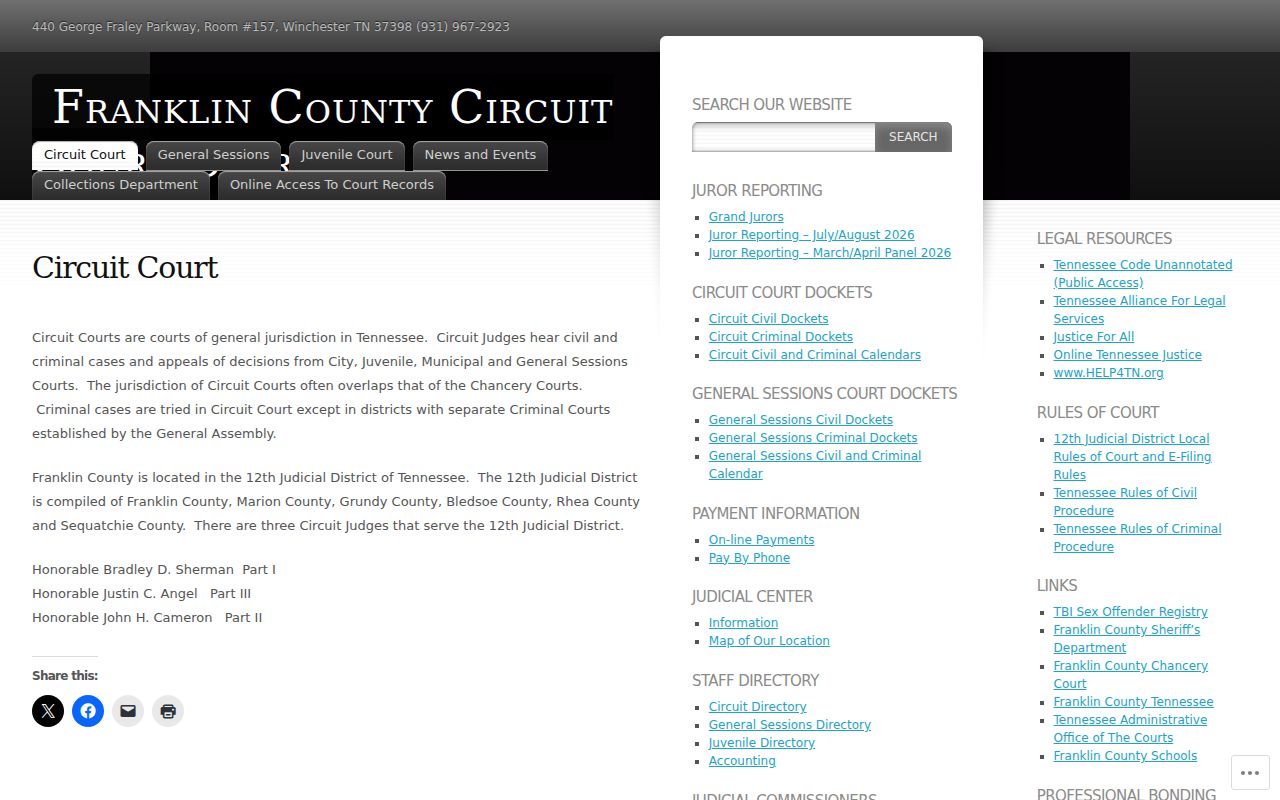
That split is why a Franklin County felony can open with a preliminary hearing in Sessions and then move up to Circuit.
| Court | Covers | Access |
|---|---|---|
| Circuit | General civil, felonies, appeals | PDF, TNCIS, clerk |
| Sessions | Limited civil, misdemeanors, preliminaries | PDF, TNCIS, desk |
| Chancery | Equity, probate, estates | Calendar, Clerk & Master |
| Municipal | City code and traffic | City clerk |
| Appellate | State appeals | Public Case History |
Franklin Sessions Docket Timing
Timing matters with the Sessions docket. Preliminary civil and criminal dockets usually post near noon the day before court, and even posted versions can shift when agencies, parties, offices, or the judge act. Need it sooner? Call the clerk.
Recheck before travel: Confirm the latest Franklin County docket setting with the proper clerk when time, room, or attendance is uncertain.
TNCIS updates once each night, while the PDF comes out the day before. Neither one tracks what happens in the courtroom as it happens.
Court Dates and Settings in Franklin County
For Circuit and Sessions dates, lean on the clerk's dated pages. Use the official calendar views too. Chancery runs its own docket-call calendar under local rules. Every case there needs a Request to Docket. Its 2026 calendar lists a District Zoom Day for limited matters. Think uncontested divorces, motions to dismiss, summary judgment, and settled announcements. Always confirm a date right before the hearing. Cases get continued, moved, or dropped, and a stale PDF never beats a later order. The Franklin County Court Schedule page keeps date checking separate from a full case history request.
Franklin Records Follow the Custodian
Robert Baggett, the Circuit Court Clerk, holds the Circuit and Sessions files. The Juvenile desk takes Juvenile filings and docket questions. Katelyn Fuller Isbell, Clerk & Master, keeps the Chancery and probate records. Each city holds its own municipal file. The Sessions jurisdiction capture shows why limited civil and criminal matters run through that office.
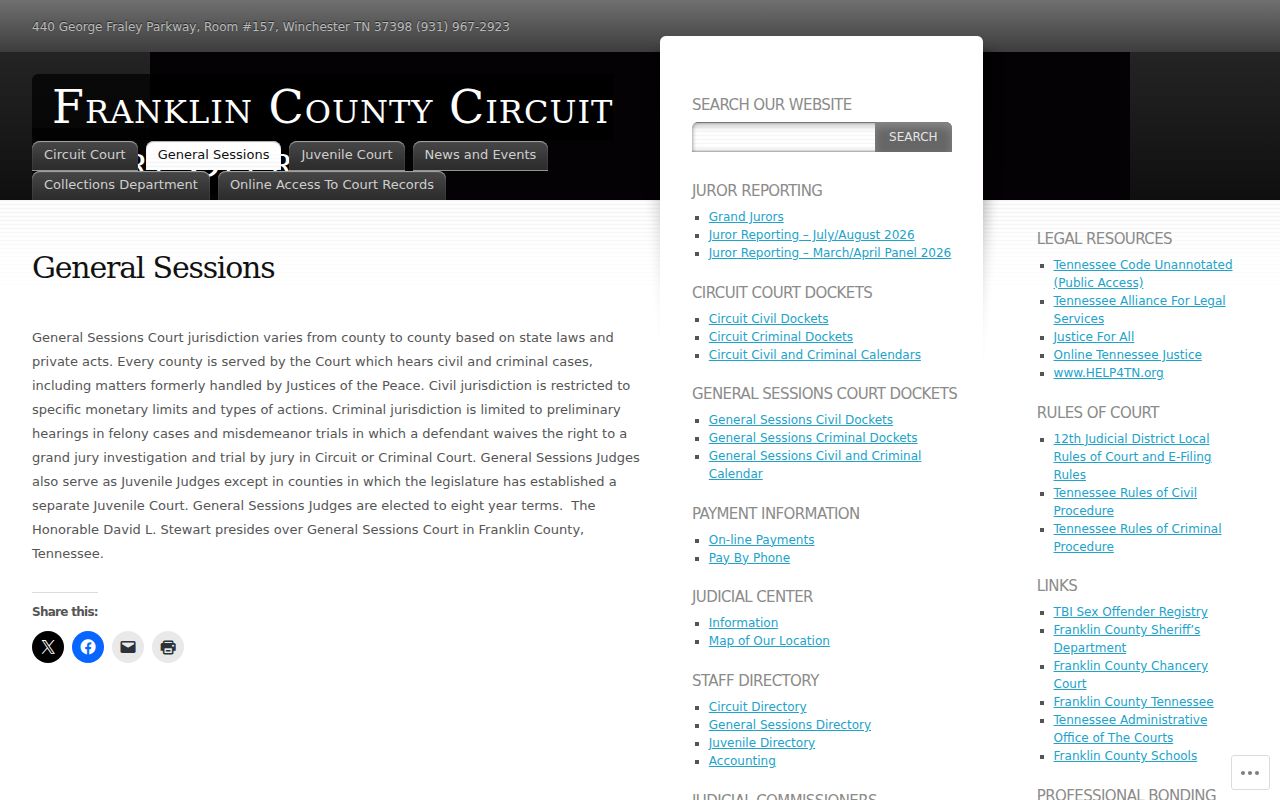
When you request a record, name the court, the record, the date range, and the case number if you have it. Also say whether you want to inspect it, get a plain copy, or have it certified. You can ask at the counter. Phone, mail, email, fax, and an online method all work too. Local policy governs. No public terminal is listed, so call the clerk first.
Docket Access Under Tennessee Law
Tennessee law lets anyone inspect a court docket, within limits set by statutes, rules, protective orders, and court orders. Requests go straight to the office holding the record, since the state keeps no central repository.
Key Rules:
Rule 34 recognizes access and express exceptions.
Tennessee Public Records Act guidance explains channels, costs, and response timing.
Rule 114 governs Juvenile confidentiality.
Rule 46A defines e-filing, but Franklin County's trial courts offer no public e-file portal.
The official Rule 34 capture presents that access framework.
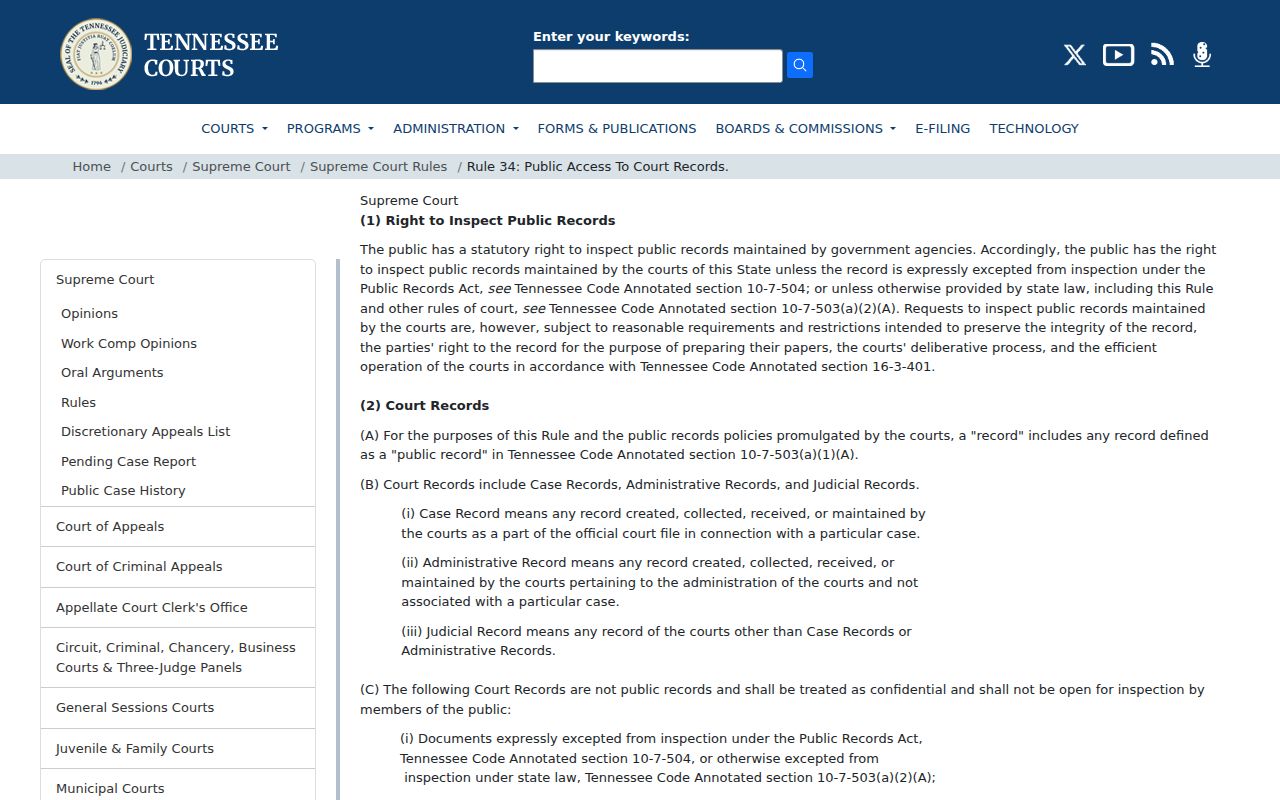
Sealed material, protected data, drafts, and judicial work product can remain outside ordinary inspection.
Restricted Franklin County Dockets
Some Franklin County dockets stay closed by law. Dependency and neglect cases are sealed under Rule 114. Delinquent and unruly cases can be open, though a judge may close one after a particularized finding of prejudice. So a juvenile docket search works differently here: talk to the Juvenile clerk about access, and skip any assumption that the adult Sessions PDF covers it.
Redactions happen too. Sealed filings, protected personal details, medical or financial information, and material under another order may be withheld or blacked out. When a docket lookup comes up empty, those rules may be the reason. That does not mean no case exists.
How the Clerk Keeps Docket Records
In Franklin County the clerk wears one hat and the judge wears another. The clerk receives filings, records fees and service, maintains the court docket, and hands out copies, while judges hear the cases and sign orders, so a docket schedule alone can never tell you how a judge finally ruled.
Franklin County Circuit Court Clerk
440 George Fraley Parkway, Room 157
Winchester, TN 37398
931-967-2923
Monday through Friday, 7:30 a.m. to 4:30 p.m.
For a chancery docket copy, ask the Clerk & Master at Box 4, or call 931-967-2843. A municipal citation belongs to the city named on the ticket. Whatever you request, open by naming the court and the paper you need.
Franklin Docket Copy Costs
Copy fees depend on which Franklin County court holds the file. Published rates include $0.50 per page, $5 for certification and seal, and $15 for three-way certification. Appeal-record preparation can cost $300 where it applies, certified mail runs its actual cost, and the Circuit, Sessions, Juvenile, and Chancery schedules each set their own charges.
| Need | Published example |
|---|---|
| Copy | $0.50 per page |
| Certification | $5 |
| Appeal record | $300 where applicable |
Ask the clerk for a current estimate before ordering anything. Tennessee public-record guidance permits different copy and labor rules, so the clerk should point you to the schedule that governs your request.
Franklin Docket Access Since 2009
The layers built up over time. The Judicial Center opened in November 2009, and Baggett became clerk in 2010. The clerk technology account dates the website to January 2012. Downloadable dockets joined automated case management then. Probate moved from Sessions to Chancery on July 1, 2014. So there is no single database. Free PDFs handle quick calendar questions. TNCIS sells case information. Chancery and the cities keep their own routes. PCH serves appeals and PACER covers federal cases, while direct service from the clerk still matters. An appeal can leave two public trails. The trial file stays with the Franklin clerk. Tennessee Public Case History covers appellate matters by case number, case style, party, or organization. Its appellate number may differ from the trial number, and its data runs through the prior business day. Federal civil, criminal, and bankruptcy cases belong to PACER instead. The Eastern District's Winchester location does not fold those federal records into the county docket. For each system, note the update cycle, and get certification from the court that owns the original file.
City-by-City Court Dockets in Franklin County
Five incorporated municipalities carry court weight here. Their 2025 certified populations set this order, not case volume. A municipal code or local traffic matter may stay with the city, while a state-law citation may name Sessions. The ticket controls.
Winchester Court Records
10,391 · City clerk and payment portal
Estill Springs Court Records
2,709 · Third-Thursday court
Decherd Court Records
2,379 · Court & Records Clerk
Cowan Court Records
1,759 · City Hall and JusticeOne
Huntland Court Records
886 · First-Monday evening court
Paying a ticket is not a certified disposition. Where a city posts no online lookup, call the municipal clerk or send a precise record request. Winchester, the county seat, runs its City Court Clerk route at City Hall alongside Municipal Online Payments. That vendor path suits a payment task, but the city offers no complete historical docket search there. Estill Springs publishes a third-Thursday setting at 3:00 p.m. at its Police Department. It accepts several payment methods. Personal checks are not accepted. Court-date and citation questions go to the listed city contact. Decherd names a Court & Records Clerk. It links a GovernmentWindow traffic option. Its public-records policy gives a second route when you need a city record rather than a payment. Cowan holds municipal court at City Hall at 3:30 p.m. The city publishes a set of 2026 dates. It also links a JusticeOne ticket portal. Its instructions tell visitors to bring photo identification, proof of insurance, and relevant receipts. Those details belong to Cowan's own setting and do not apply to another Franklin County court. Huntland schedules court on the first Monday of each month at 6:00 p.m. A posted change can shift that date. The town's official schedule has shown a holiday shifting that recurring date. You can pay at the town office, by mail, or by phone. Cards carry a convenience fee. The town posts no online citation lookup. Calling the town is a genuine access channel, not a fallback after a failed county docket search. Across all five cities, the issuing court is the key fact. A city ordinance matter stays out of the Franklin County Circuit Clerk's free PDFs. It will not appear in the TNCIS description either. A ticket naming General Sessions belongs with the county route instead. Keep the ticket. Note its citation or case number. Then ask the city custodian for the day's docket, recorded disposition, ordinary copy, or certified copy as needed. A record may not be online. In that case a detailed Tennessee public-record request should name the city, court, date range, record type, and preferred delivery method. The custodian can then state any access limit, copy fee, or certification requirement.
Map and Directions to the Franklin County Judicial Center
Circuit, General Sessions, Juvenile, Chancery, and Child Support records are all kept at the Franklin County Judicial Center, which opened in November 2009 at 440 George Fraley Parkway in Winchester. The Circuit Court Clerk's counter is in Room 157, and the same building houses the Clerk & Master, probation, and a domestic-violence-advocate office.
Franklin County Judicial Center
440 George Fraley Parkway, Room 157
Winchester, TN 37398
931-967-2923
Monday through Friday, 7:30 a.m. to 4:30 p.m.
Everyone entering passes through a security checkpoint where bags are screened in a tray and visitors walk through a metal detector; weapons, food and drink, tobacco, and pepper spray are prohibited, and smoking is barred within 100 feet of the entrance. Courtroom dress rules bar hats, cut-offs, shorts, sagging clothing, and bare midriffs, so plan attire before a hearing.